Revitalization.
That's the word i kept circling back to by the end of my day in Sendai, though i had no idea that was coming when i woke up.
Our next stop after the ferry. i'll be honest about how that morning started, because the contrast is the whole point. the night before, still riding the high of hokkaido, i shotgunned a drink with the guys and then went down to the onsen while the ship rocked through open water. floating in hot water, watching the dark ocean tilt past the window, half-laughing at how unreal it all was. that was me less than twelve hours
We docked in sendai in the morning and went straight to the 77 bank. i expected a dry presentation and instead got a whole pitch about saving a region. they don't really talk like a bank. they talk like a development partner, like the survival of miyagi is part of their job description. they walked us through vision 2030, through tohoku university and the nanoterasu research facility and the semiconductor companies setting up nearby. i asked how they actually back r&d startups beyond just handing out loans, and whether venture funding fit into the plan. the answer was yes, and that they're moving that direction because deep-tech companies can't survive on debt alone. a bank putting equity into its own region's future felt like a real shift to me.
Then we drove out to arahama elementary school, and the day changed key.
The coast there is flat in a way that feels wrong once you know what happened. nothing to slow the water down. the school is preserved exactly as the 2011 tsunami left it: water lines high on the second floor, a car still crushed into the side of the building, classrooms left mid-collapse. they keep it that way on purpose. the damage is the memorial. i stood on the rooftop where people waited to be rescued and looked out at all that empty space where homes and farms used to be, and i understood something that no lecture had managed to put in me. one survivor compared remembering the tsunami to remembering the war, a responsibility each generation has to inherit. another said she couldn't celebrate her birthday afterward because being happy felt wrong while others were suffering. i haven't been able to put that down since.
The last stop was sendai daisan high school, and an exchange with japanese students. my group ended up with students who spoke very little english and classmates who spoke very little japanese, and me somewhere in the middle of it. it could have stalled completely. it didn't. we built the conversation out of gestures, simple words, phones, patience, and somehow it worked. we landed on something i keep turning over. one of the japanese students said it simply, almost offhand, and it hit the whole table at once: "when you learn a language, you learn a culture." not grammar. not vocabulary. the whole way a people see the world. sitting in that gap and making a real connection across it instead of around it, i understood exactly what he meant. you cannot translate your way into a culture. you have to walk into it.
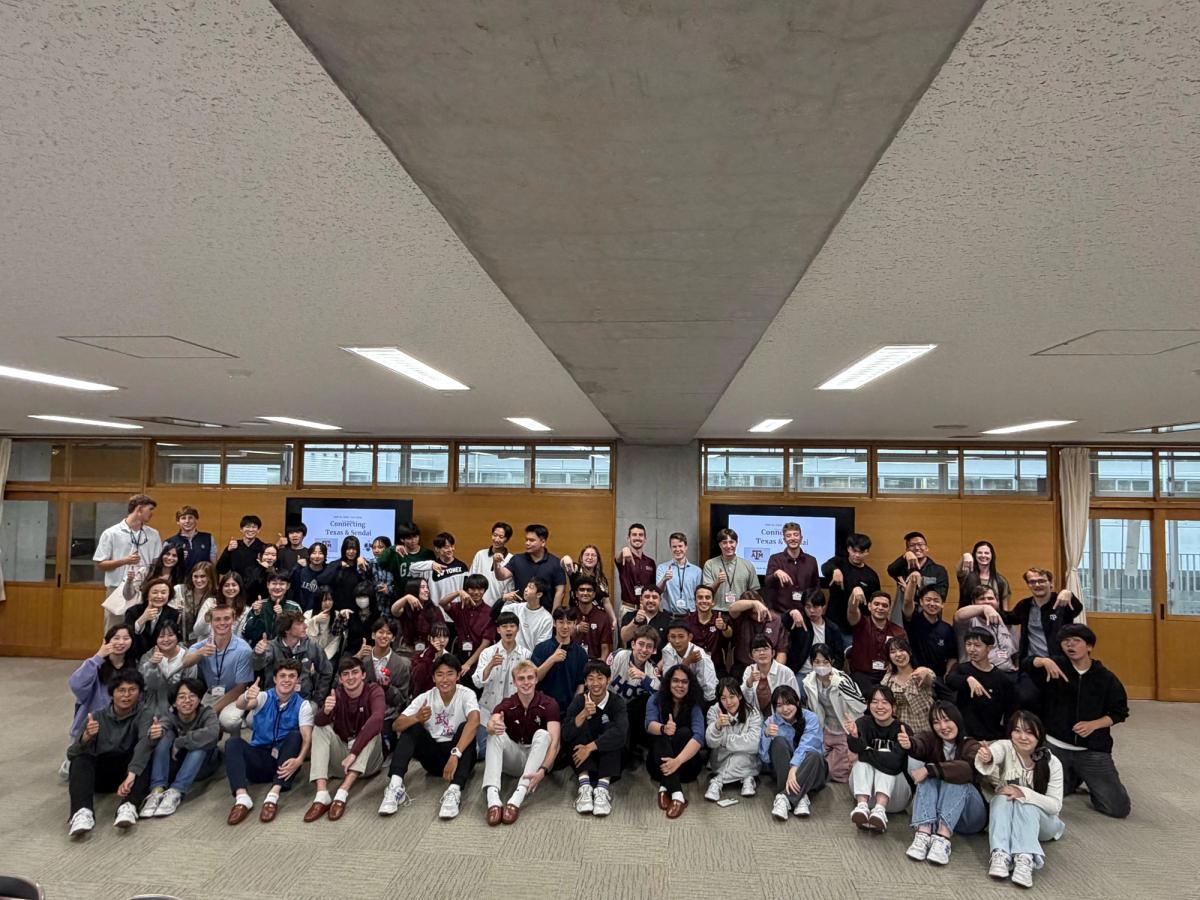
sixty people who barely shared a language, and somehow the room felt full
By the time i got to dinner i could see the thread. the bank, the memorial, the high school. all of it was the same story told three ways. a region fighting to hold onto its people, its memory, and its future, all at once. revitalization isn't only about money or rebuilding. it's about refusing to forget, and refusing to let a place quietly disappear.
I started the day drunk and weightless in a bath on a moving ship. i ended it thinking about memory, responsibility, and how people survive hard futures by holding onto each other. sendai gave me both, and somehow they belonged to the same day.